Categories
Insights

Trading the Freeze: Finding Edge in the Closing Auction Session

How a structural quirk of expiry-day microstructure creates a repeatable — if capacity-limited — opportunity in Indian index options.

Batra Hedge · Research Note · September 2026


Most market participants think of the trading day as ending in a single, tidy moment: the closing bell. In reality, the last fifteen minutes of an Indian expiry day are among the most structurally interesting of the entire session — and, for a firm built to study market microstructure, among the most fertile.

This note explains a window we have spent considerable research effort on: the Closing Auction Session (CAS). It describes what the window is, why it creates a genuine dislocation, and how we have approached it. It also, deliberately, tells you what we cannot claim — because at Batra Hedge we would rather be trusted than impressive.

What the Closing Auction Session actually is

To curb manipulation and volatility around the closing price, the exchanges introduced a call-auction mechanism for the cash-equity segment near the close. On an expiry day, the effect is striking: continuous trading in the underlying stocks halts in the mid-afternoon, the market collects orders into an auction, and a single equilibrium closing price prints a few minutes later.

Here is the quirk that matters. During that auction window, the index options and futures keep trading continuously. So for roughly ten minutes, the index itself has no live, continuously-updating price — its constituent stocks are frozen in an auction — while the derivatives written on that index trade on, tick by tick.

The underlying goes dark. The options stay lit.

Why that creates an edge

When the continuous underlying disappears, three things happen at once, and each is a source of opportunity for a disciplined systematic trader:

Price discovery migrates into the options book. With no live index tick, the only instruments still expressing a view on where the index will settle are the options and the future. The “true” index level during the freeze effectively lives inside the derivatives — recoverable, for those who know how to read it, from the relationship between calls and puts.

Uncertainty spikes, then resolves. Nobody knows exactly where the auction will clear until it prints. That uncertainty inflates the value of optionality in the expiring series. The moment the auction resolves, the uncertainty collapses — and so does that inflated premium.

Liquidity providers pull back. Market-makers who normally quote tight because they can continuously hedge in the underlying lose that ability during the freeze. Spreads widen; quotes lag; the book becomes, in a word, dislocated.

None of this is a secret in the sense of being hidden — it is a direct consequence of how the auction is designed. The edge is not in knowing the window exists. It is in the engineering and research required to trade it cleanly: reconstructing the index in real time when the exchange isn’t publishing one, distinguishing genuine mispricing from noise inside a fast, thin, wide book, and — above all — managing risk into an event whose outcome is unknown until it prints.

Our approach: medium-frequency, defined-risk

We trade this window with a medium-frequency (MFT) system. That description is doing real work, so it’s worth unpacking.

We are not a high-frequency shop racing to shave microseconds; the CAS edge does not require, and our thesis does not depend on, winning a latency arms race. Nor is this discretionary end-of-day punting. Our system operates on the timescale the opportunity actually lives on — signals that form and decay over seconds to minutes across a ~10–15 minute window — and it acts systematically, without a human in the loop deciding each trade.

Two principles govern everything downstream of the signal. The first is defined risk: every position carries a known, bounded worst case before it is put on. The second is discipline into the print: the system is built to be flat, or deliberately and precisely positioned, before the auction resolves — never carrying an unhedged directional bet into a coin-flip. We would rather forgo a good outcome than accept an uncontrolled one.

We are not disclosing the specific signals or parameterization here. What we will say is that the strategy is the product of the same infrastructure that underpins the rest of Batra Hedge’s work: rigorous backtesting against high-resolution data, a realistic cost and slippage model, and a live execution stack we control end to end.

The result — with the caveats that make it meaningful

Over a one-month evaluation period, the strategy generated a net return of approximately 3.3% on the capital allocated to the CAS window.

We want to be very clear about what that number is and is not.

It is a single month — a small sample, over which luck and skill are difficult to separate. It is not annualized, and we would ask you not to annualize it; extrapolating one favourable month into a yearly figure would be exactly the kind of statistical overreach we built this firm to avoid. It reflects performance within a specifically-sized, capacity-constrained window — the CAS opportunity is, by its nature, narrow and thin, and we do not believe it scales indefinitely. And it is, like all trading, subject to regime change: a structural edge today can erode as more participants recognise it, as the auction rules evolve, or as liquidity conditions shift.

We report it because it is real and because transparency with our partners matters more to us than a cleaner headline. We caveat it heavily because anything less would be misleading — and because sophisticated allocators, in our experience, trust the firm that volunteers the limitations before being asked.

What this says about how we work

The Closing Auction Session strategy is a small piece of Batra Hedge’s book. But it is a fair representation of our method: find a structural feature of the market that is hiding in plain sight, do the unglamorous engineering to trade it cleanly, size it honestly, and never confuse a good month with a proven edge. The Indian derivatives market is young, fast-evolving, and full of these structural seams. Studying them well is what we do.


Important disclosures

Batra Hedge is a multi-strategy private hedge fund, researching and deploying invite only private capital in proprietary models.

This note is published for informational and educational purposes only. It does not constitute investment advice, a research report, or an offer or solicitation to buy or sell any security, strategy, or fund interest. The performance figure discussed reflects a single one-month period, represents a limited sample, is not annualized, and is not indicative of future results. All trading and investment involve the risk of loss, including the loss of principal. Strategies that exploit specific market-microstructure conditions are inherently capacity-constrained and regime-dependent, and may cease to be effective without notice. Any figures are gross of any fees not explicitly stated and may reflect assumptions about execution, costs, and market conditions that will not be realised in practice. Nothing herein should be relied upon as a promise or representation as to future performance. Readers should consult their own financial, legal, and tax advisers before making any investment decision.

Categories
Insights

Closing Auction Settlement (CAS)

The Biggest Market Structure Shift in Indian Derivatives Since Weekly Expiries?

Financial markets don’t change overnight—but occasionally, a regulatory reform fundamentally changes how participants trade, execute, and manage risk.

India’s move towards Closing Auction Settlement (CAS) is one such structural shift.

While much of the discussion has focused on expiry settlement, CAS is far more than a procedural change. It has the potential to reshape liquidity, execution behaviour, algorithmic trading, brokerage revenues, and institutional participation.

Every participant in the market ecosystem will feel its impact differently.

Some will benefit immediately.

Others will need to rebuild years of research.

And as with every structural reform, entirely new opportunities will emerge.


What is Closing Auction Settlement (CAS)?

Closing Auction Settlement determines the settlement price through a structured closing auction instead of relying solely on the last traded price.

Rather than encouraging participants to influence prices in the final seconds of trading, orders are aggregated during an auction window where demand and supply collectively determine the closing price.

The objectives are clear:

  • Improve price discovery
  • Reduce settlement price distortion
  • Strengthen market integrity
  • Increase institutional confidence
  • Align Indian markets with global best practices

For long-term investors, this is largely positive.

For active traders, however, the market microstructure changes significantly.


1. Asset Management Companies (AMCs)

Among all stakeholders, asset management companies are arguably the biggest beneficiaries.

Index Funds: Lower Tracking Error

Passive investing has grown rapidly in India, making execution quality increasingly important.

Index funds aim to replicate benchmark returns as closely as possible. Small differences between the index closing value and the fund’s execution price create tracking error, which compounds over time.

A transparent closing auction enables fund managers to execute closer to the benchmark closing price, improving replication efficiency.

Potential benefits include:

  • Lower tracking error
  • Better benchmark replication
  • Reduced execution costs
  • More efficient portfolio rebalancing

As passive investing continues to grow, these improvements become increasingly valuable.


Arbitrage Funds: A More Efficient Settlement Process

Arbitrage funds rely on pricing relationships between the cash and derivatives markets.

A more transparent settlement mechanism can:

  • Improve price convergence
  • Reduce uncertainty around expiry
  • Improve execution quality
  • Lower settlement-related risk

While arbitrage opportunities may become more efficient, the quality of execution is expected to improve for institutional participants.


2. Broking Companies

For brokers, CAS is less about reducing activity and more about redistributing it.

Liquidity May Shift Towards the Close

Today’s trading volumes are spread relatively evenly across the session.

With CAS, institutional participants may increasingly choose to execute during the closing auction to achieve benchmark-quality execution.

This could lead to:

  • Lower intraday trading activity during certain periods.
  • Higher concentration of liquidity in the final minutes.
  • Increased importance of execution services near the close.

The overall market may not become less active—but its liquidity profile could change significantly.


Monthly Expiry Days Could Become Auction Events

Monthly expiries are already among the busiest trading sessions.

Under CAS, they may evolve into major auction-driven liquidity events, with significant institutional participation concentrated around the closing auction.

For brokers, this means:

  • Greater emphasis on auction execution capabilities.
  • Higher demand for algorithmic execution tools.
  • Increased importance of order management systems designed for auction participation.

Execution quality may become an even stronger competitive differentiator than transaction costs.


3. HFT, MFT and Proprietary Trading Firms

Not all systematic traders are affected in the same way.

High-Frequency Trading (HFT)

HFT firms compete on latency, execution speed, and liquidity provision.

CAS creates both opportunities and challenges.

Potential opportunities include:

  • Higher liquidity during the closing auction.
  • Auction-specific market-making strategies.
  • Increased demand for sophisticated execution algorithms.

Potential challenges include:

  • Reduced continuous intraday liquidity if institutional flow shifts toward the auction.
  • Greater competition around the closing auction window.
  • Recalibration of execution and inventory management models.

For HFT firms, the edge shifts rather than disappears.


Medium-Frequency Trading (MFT)

MFT firms typically hold positions for minutes to hours and rely on intraday statistical relationships, momentum, and execution alpha.

These firms may face a larger adjustment because many of their models are built on historical intraday behaviour.

Potential impacts include:

  • Changing liquidity distribution.
  • Altered expiry-day price dynamics.
  • Different intraday volatility patterns.
  • Execution models requiring extensive retraining.

Many strategies will need to be revalidated under the new market structure.


Proprietary Trading Firms

Prop firms thrive by identifying repeatable inefficiencies.

Whenever market structure changes, historical assumptions become less reliable.

Firms may need to:

  • Rebuild execution models.
  • Update slippage assumptions.
  • Modify risk management frameworks.
  • Rethink expiry-day strategies.
  • Invest in fresh research rather than relying on historical performance.

For firms with strong quantitative research capabilities, CAS represents a new research cycle rather than merely a disruption.


4. Quant Traders vs Retail Traders

The impact of CAS is likely to be very different for quantitative traders and retail investors.

Quantitative Traders

Quantitative strategies are built on historical data.

Years of backtesting assume certain relationships between liquidity, volatility, order flow, and price behaviour.

CAS changes one of those fundamental assumptions.

Many intraday strategies may experience a decline in performance—not because the strategy itself is flawed, but because the underlying market structure has evolved.

Quant firms will need to:

  • Retrain models using post-CAS data.
  • Update execution assumptions.
  • Rebuild transaction cost estimates.
  • Develop auction-aware execution algorithms.
  • Search for new sources of alpha.

History suggests that every structural reform removes some inefficiencies while creating entirely new ones.

The firms that adapt fastest often become the next market leaders.


Retail Traders

Retail investors may experience the least direct impact.

Most long-term investors are unlikely to notice any meaningful difference beyond potentially improved closing price discovery.

However, active intraday traders should be aware that:

  • Liquidity patterns may change.
  • Expiry-day behaviour could evolve.
  • Execution near market close may become more competitive.
  • Traditional intraday trading patterns may gradually shift.

Understanding the changing market microstructure will become increasingly important for active traders.


The Bigger Picture

Indian derivatives markets have witnessed several structural changes over the past decade:

  • Peak margin implementation
  • Weekly and daily expiry changes
  • Leverage reductions
  • Margin framework reforms
  • Product rationalisation
  • And now, Closing Auction Settlement

Each reform initially disrupted established strategies.

Each reform forced participants to adapt.

Each reform also created new opportunities for those willing to rethink their assumptions.

Markets rarely reward those who resist change.

They reward those who understand it first.


Final Thoughts

Closing Auction Settlement is not merely a change in settlement methodology—it represents another step in the maturation of India’s capital markets.

For long-term investors, it promises more robust price discovery and potentially better execution quality.

For brokers, it may reshape where and when liquidity is concentrated.

For HFTs, MFTs, prop desks, and quantitative traders, it marks the beginning of a new market regime—one where historical edges may weaken, but fresh opportunities emerge.

The greatest competitive advantage in financial markets has never been predicting regulatory change.

It has always been adapting faster than everyone else once the change arrives.

At Batra Hedge, we believe market structure is just as important as market direction. Every evolution in market design changes where alpha can be found—and those who study the microstructure closely are often the first to discover the next generation of opportunities.

Categories
Insights

Squash & Investing!

At first glance, squash and investing couldn’t be more different.

One is played on a court.

The other is played in financial markets.

Yet both reward the same qualities: discipline, patience, positioning, and the ability to recover.

Here are five lessons every investor can learn from the game of squash.


1. The T-Point Is Your Neutral Position

The first lesson every squash player learns is to return to the T-point after every shot.

Why?

Because from the center of the court, you can reach every corner with the least effort.

The T-point isn’t where points are won.

It’s where the next point is prepared.

Investing has its own T-point.

For a market maker, it is delta neutrality.

For a long-term investor, it is a well-balanced asset allocation.

Markets constantly pull portfolios away from equilibrium. Prices rise, volatility changes, and correlations shift. Successful investors don’t remain stretched in one direction—they rebalance and return to their center.

The goal isn’t to predict every move.

The goal is to always be in the best position for the next one.


2. Control the Court, Don’t Chase the Ball

Beginners spend the entire match chasing the ball.

Professionals control the center and make their opponent do the running.

Many investors make the same mistake.

They chase hot sectors, trending stocks, and yesterday’s winners.

Professional investors don’t chase markets.

They build portfolios that allow opportunities to come to them.

Discipline beats excitement.


3. Winning Comes From Hundreds of Good Shots

A squash match is rarely won with one spectacular winner.

It is won through consistent shot selection, intelligent positioning, and minimizing mistakes.

Investing works the same way.

Long-term wealth is rarely created by finding one “multibagger.”

It is built through thousands of sound decisions:

  • Managing risk
  • Staying invested
  • Rebalancing regularly
  • Letting compounding do the heavy lifting

Consistency compounds.


4. Every Rally Is Different

No two rallies are identical.

Sometimes you attack.

Sometimes you defend.

Sometimes you simply keep the ball in play until the opportunity arrives.

Markets behave the same way.

Bull markets, bear markets, high-volatility periods, and quiet ranges all demand different approaches.

Successful investors don’t force one strategy onto every market.

They adapt while staying true to their process.


5. Recovery Matters More Than Perfection

Even world champions are occasionally pushed into the corners.

The difference is what happens next.

They recover immediately and return to the T-point.

Investors will also experience drawdowns.

No portfolio wins every year.

No strategy avoids losses forever.

The winners aren’t those who never lose.

They’re the ones who recover quickly, rebalance intelligently, and remain emotionally disciplined.


The Batra Hedge Perspective

At Batra Hedge, we view investing much like a game of squash.

Markets will always move.

Volatility will always test your positioning.

Our objective isn’t to predict every shot the market will play. It is to remain balanced, disciplined, and prepared for whatever comes next.

Because in squash, championships are won by returning to the T-point.

In investing, long-term wealth is built by continually returning to balance.

“The game is the reward.”

“The key is not the will to win. Everyone has that. It is the will to prepare to win that is important.”

“It’s difficult to compete with a group of people who are having fun!”

Cheers!
Bhuvan P Batra

Categories
Insights

The Seven Layers of a Trading Firm

Inspired by a conversation with Pawan Chugh, a teacher at the Art of Living.

Last week, a teacher explained to me why some people meditate for years and stay restless, while others find stillness quickly. His answer had nothing to do with effort. It had to do with alignment.

In the Art of Living tradition, a human being is not one thing. We are seven layers stacked into a single life: the body, the breath, the mind, the intellect, the memory, the ego, and the self. When these layers pull against each other, you suffer. When they move together, you find peace. Meditation, breath, and yoga exist for one reason — to bring the seven into harmony.

I walked out of that conversation and realized he had just described how to build a trading firm.


The body is your infrastructure. Servers, brokers, APIs, execution systems, capital, risk plumbing. It is unglamorous and invisible until it fails. A restless mind cannot meditate in a sick body, and no strategy survives on a system that drops orders. Everything else is a luxury you earn by getting this right first.

The breath is the market itself. Liquidity, order flow, volatility, the rhythm of price expanding and contracting. Markets inhale and exhale. Most traders fight the breath, forcing trades when the market is holding still. The disciplined ones learn to watch it — and to move only when it moves.

The mind is your strategies. The ideas, the hypotheses, the signals. This is the layer everyone romanticizes, and the layer that matters least on its own. The mind is a fountain of opportunities, most of them noise.

The intellect is your research engine. Backtesting, statistical validation, portfolio construction, the models that separate a real edge from a flattering coincidence. If the mind generates a thousand ideas, the intellect is the quiet judgment that discards nine hundred and ninety.

The memory is your data. Price history, trade logs, drawdowns, the scars of every regime you’ve survived. A firm without memory repeats its worst year on schedule. A firm that remembers learns to see the storm before it arrives.

The ego is your risk management — and it is the most dangerous layer of all. Ego is what makes you double down to prove you were right. It is revenge trading, oversized positions, the certainty that the market is wrong and you are not. A healthy ego gives you the confidence to act. An unchecked one quietly writes your obituary. Real risk management is not a spreadsheet. It is the discipline to obey the system instead of yourself.

And the self is your philosophy — the unchanging thing beneath all the noise. For me, for Batra Hedge, it is this: to create sustainable cash flow through disciplined quantitative investing, while preserving capital above all. When markets scream and every layer above is in chaos, the self is what keeps you pointed at the mission instead of the moment.


Here is what the teacher understood that most quants never do.

The firms that win are not the ones with the cleverest algorithm. Algorithms are the mind — and the mind is cheap. The firms that endure are the ones aligned across all seven layers: strong infrastructure, honest research, disciplined execution, a long memory, a quiet ego, and a philosophy that doesn’t flinch.

Great returns aren’t a signal you found. They’re a state of harmony you built.

Body gives you the ability to act. Breath tells you what’s real. Mind finds the opportunity. Intellect filters it. Memory teaches you. Ego, unmanaged, undoes you. And the self keeps you whole.

Same for a person on the mat. Same for a firm in the market.

Categories
Insights

What the Fifa World Cup Can Teach Us!

Right now, the 2026 FIFA World Cup is underway across the United States, Mexico, and Canada — the first edition to feature 48 teams, 12 groups, and 104 matches across 16 stadiums. It is, by most measures, the most watched sporting event on the planet, pulling in billions of viewers across traditional broadcast, YouTube, and TikTok. Every four years, this tournament becomes a live case study in human coordination under pressure — and if you look closely, nearly every theme that defines a great World Cup campaign has a direct parallel in markets, portfolio management, and algorithmic trading.

Team Building: Assembling the Right Mix

A World Cup squad is not built by picking the 23 most talented individuals — it is built by picking players whose skills complement each other under a system. A team stacked with strikers and no midfield control collapses under pressure, no matter how much individual talent it holds.

Portfolio construction works the same way. A basket of the “best” individual stocks or strategies, chosen in isolation, can still produce a fragile portfolio if they are all correlated and fail together in the same regime. Good investing, like good squad-building, is about assembling uncorrelated, complementary positions — a defense (hedges, low-beta assets), a midfield (steady compounders), and an attack (high-conviction, high-upside bets) that work as a system rather than a pile of individually impressive parts.

Coordination: Execution Is Everything

A perfectly drawn-up attacking move is worthless if the timing of the run, the pass, and the first touch aren’t synchronized to the millisecond. Elite teams win not because they have better ideas than everyone else, but because they execute those ideas with tighter coordination.

This is almost a literal description of algorithmic trading. A strategy can have real statistical edge and still lose money if execution is poorly coordinated — if order routing, latency, slippage control, and risk checks aren’t synchronized as tightly as a well-drilled midfield. In both worlds, the edge lives in the gap between “we know what to do” and “we did it at the right instant.”

Communities: The Power of Collective Belief

Fan communities create something no individual player can: shared belief that amplifies performance, sustains loyalty through losing streaks, and turns a stadium into a genuine home advantage. That same collective psychology shows up in markets — retail investing communities, copy-trading platforms, and online forums can move prices independently of fundamentals, for better or worse. Understanding market communities — where sentiment clusters, where crowding builds up, where a “home crowd” of momentum traders is pushing a trade — is now as relevant to a trader as reading order flow.

Emotion and Connection: The Thing Algorithms Are Built to Remove

Nothing captures raw emotion like a last-minute goal or a missed penalty. That emotional intensity is also exactly why humans make poor investment decisions — chasing a rally out of FOMO, panic-selling a drawdown, holding a loser too long out of attachment. Algorithmic trading exists, in large part, to strip emotion out of execution: rules-based entry and exit, no revenge trading after a loss, no doubling down out of hope. The irony is that the same emotional connection that makes football magical to watch is the exact liability a systematic trader is trying to engineer out of their own decision-making.

Branding: Value Beyond the Scoreline

The FIFA World Cup emblem, host-city identities, and team crests aren’t cosmetic — brand equity is a real, monetizable asset that outlives any single tournament result. A club or federation with strong branding commands better sponsorship, media rights, and merchandising value regardless of a temporary slump in form.

The same logic applies to companies and to trading firms. A strong brand — investor trust, a track record of risk discipline, a recognizable philosophy — lets a fund or a company weather a bad quarter without an existential crisis of confidence. Brand is a buffer against short-term variance, in football and in finance.

Sponsors: Capital That Enables the Game

None of this happens without capital. FIFA’s tiered sponsorship structure — global partners like Adidas, Visa, and Coca-Cola, tournament-level sponsors, and regional supporters — funds the infrastructure, the broadcast reach, and the prize pools that make the tournament possible.

In investing, sponsors take the form of LPs, allocators, and capital partners who fund a strategy before it’s proven itself in live markets. Just as FIFA’s sponsors expect governance, transparency, and brand alignment in return for their capital, investors and allocators expect risk controls, reporting, and consistency from the strategies they back. Capital and trust flow together in both worlds — no sponsor, no tournament; no allocator, no fund.

The Common Thread

Strip away the stadiums and the tickers, and the World Cup and the market are running the same underlying game: individually skilled agents, operating under a system, competing for a limited prize, watched by a crowd whose emotions feed back into the outcome. The teams — and the traders — that win consistently aren’t the ones with the flashiest highlight reel. They’re the ones with the best structure, the tightest coordination, and the discipline to keep emotion out of the moments that matter most.

Categories
Insights

Batra Agarwood LLP

Liquid Gold & Pole Position: Why the Rarest Things in the World Are Never Found — They’re Earned

The Tree That Refused to Die

Somewhere deep in the forests of Southeast Asia, a tree gets wounded.

A fungal infection spreads through its heartwood. For most trees, this is the end — rot sets in, the wood decays, the tree is forgotten. But certain trees, the Aquilaria, respond differently. Faced with an existential threat, they do something extraordinary.

They fight back.

The tree begins producing a dark, dense, aromatic resin — flooding the infected wood, hardening it, transforming it. Over years, sometimes decades, this biological response creates something the world has never been able to replicate or rush: Agarwood.

It has no equal. Ounce for ounce, it trades at prices that rival gold. A single kilogram of the finest grade — Kyara — can fetch over $100,000. Perfume houses in Paris hoard it. Royalty in the Gulf burns it at ceremonies. Collectors in East Asia have bought entire estates just to secure a supply.

The world has been chasing Agarwood for over a thousand years.

And still, it cannot be manufactured. It cannot be hurried. It cannot be faked.


Why the Whole World Chases It — And Why Most Never Find It

The paradox of Agarwood is this: the harder you hunt for it, the more elusive it becomes.

Wild Agarwood now accounts for less than 2% of Aquilaria trees in the forest. Poaching, over-harvesting, and impatient cultivation have stripped the world’s supply. Plantation-grown Agarwood exists — but connoisseurs can tell the difference in one breath. The complexity, the depth, the soul of wild Agarwood simply cannot be replicated in five years what nature took forty years to build.

This is what makes it not just rare, but mythically rare. It is the kind of rare that makes people travel across continents. Rare in a way that makes its price not a ceiling, but a floor.

Three qualities define it:

Rarity. It cannot be scaled. There is no shortcut, no technology, no capital injection that accelerates the Aquilaria’s resin response. Time is the only ingredient that cannot be purchased.

Exclusivity. Every piece is unique. The specific tree, the specific wound, the specific decades of pressure create a fingerprint that cannot be cloned. Owning genuine Agarwood is owning something irreplaceable.

The Chase. Its scarcity creates a pursuit culture. The world’s most discerning buyers — heads of state, sovereign wealth funds, generational dynasties — they don’t buy Agarwood at a counter. They cultivate relationships with sources over years, sometimes decades. Because when it becomes available, you need to already be known.


The Lesson Most Investors Miss

Here is what the Agarwood tree teaches us about capital:

Pressure is not the enemy of value. Pressure is value, in the making.

Every year the market sells off in panic, every quarter where patience is tested, every cycle where short-term thinkers capitulate — these are the wounds that, for the disciplined investor, create the resin. The depth. The irreplaceable quality that no bull-market late-comer can ever replicate.

The investors who compound wealth across generations are not the ones who chased the loudest trend. They are the ones who understood what they were building — and refused to be rushed.

Real wealth is built slowly, under pressure, and worth every year of the wait.


The Formula One Parallel: What It Actually Takes to Win

Now shift the frame entirely. Picture the starting grid at Monaco.

Twenty cars. Twenty drivers. Billions of dollars on the line. The race lasts ninety minutes — but it is won or lost long before the lights go out.

Because winning a Formula One race is never about one thing. It has never been about one thing. The sport has a quiet truth that the cameras rarely capture:

Three elements must align perfectly. Remove any one of them, and you don’t win — you finish.


Element One: The Driver

The driver is the edge. The instinct. The person who, entering Turn 1 at 300 km/h with six cars wheel-to-wheel, makes the decision that wins the race.

But here is what most people misunderstand about F1 drivers: their genius is not bravery. It is precision. The ability to feel the car, read the data, manage tyre degradation, execute a strategy under extreme stress — lap after lap, for ninety minutes, with no margin for error.

A driver without the right car finishes tenth. A driver without the right backing drives for a midfield team their whole career. But the right driver, given the right conditions — they become legend.


Element Two: The Brand (The Sponsor, The Institution)

No team in Formula One history has ever won a championship without institutional backing.

Ferrari didn’t just build a car. They built an empire — engineering talent, supply chains, decades of institutional knowledge, sponsor relationships that fund hundreds of millions in development each year. Red Bull didn’t arrive as a drinks company. They built a racing architecture, invested in a talent pipeline from junior series, and created an ecosystem where winning was the only acceptable outcome.

The brand and its backing is the structure around the driver. It is the system that turns raw talent into consistent results. Without it, the driver is unprotected. Without it, a single bad race becomes a spiral. The institution provides capital, credibility, and the infrastructure to learn from failure without being destroyed by it.

This is why sponsors don’t just write cheques. The best ones understand that they are co-architects of an outcome. They provide stability, they demand accountability, and they think in seasons — not single races.


Element Three: The Racing Track

Infrastructure is invisible when it works — and catastrophic when it doesn’t.

The circuit is the operating environment. The pit lane, the timing systems, the telemetry feeds streaming back to the engineering wall in real time. Tyre temperature sensors. DRS zones. Fuel load calculations. The microseconds between a slow pit stop and a perfect one.

In modern F1, the car is a rolling supercomputer. The entire operation around it — the track, the pit wall, the data pipeline — is what translates driver skill and team investment into actual lap time. You can have the best driver on the grid and the deepest-pocketed sponsor. If your infrastructure fails you, you’re out.


Now Apply This to Algorithmic Trading

The parallel is not a metaphor. It is a blueprint.


The Driver = The Trader / The Algorithm

The alpha source. The signal. The intellectual edge that sees what the market has not yet priced.

In algorithmic trading, this is the strategy — the specific pattern recognition, the factor model, the execution logic that generates returns. It must be sharp, adaptive, and disciplined. It must know when to press and when to stand down. It must read market conditions the way Verstappen reads a deteriorating tyre.

But raw alpha is worth nothing without the structure to support it.


The Brand / Sponsor = The Family Office or Institution

This is the capital, the credibility, and the mandate.

A trading strategy backed by a serious family office or institutional partner doesn’t just have money. It has governance. Risk committees. Drawdown limits that protect the strategy from being shut down at exactly the wrong moment. Patient capital that doesn’t pull out after two difficult weeks.

The institution is the sponsor that builds the winning team. They don’t just fund the race — they fund the season. They understand that a strategy which loses money in February and makes it back threefold by October is a strategy worth backing. They provide the environment in which alpha can compound.

Without this backing, even the sharpest trading mind is one bad month away from being shut down.


The Racing Track = The Infrastructure

Execution. Latency. Co-location. Data feeds. Order management systems. Risk management pipes. Connectivity to liquidity venues.

This is the operating environment of the trade. Every millisecond matters. The difference between a strategy that runs on robust, low-latency infrastructure and one that doesn’t is not marginal — it is structural. Slippage, missed fills, system lag: these are the invisible costs that erode alpha quietly, race after race, until the edge is gone.

The best strategies, run on inadequate infrastructure, underperform. The same strategy, run on the right infrastructure, outperforms — not because it got smarter, but because it stopped losing to friction.


The Batra Hedge Thesis

This is precisely what Batra Hedge was built around.

We are not in the business of chasing trends. We do not sell the promise of outsized returns without a framework that can actually deliver them. We understand — viscerally, structurally — that the three elements must align.

The right algo. The right institutional partnership. The right infrastructure.

Remove one, and you are not building a compounding machine — you are building fragility dressed up as strategy.

Like Agarwood, what we are building cannot be rushed. The returns that compound across a decade look nothing like the returns that spike in a quarter and collapse in the next. What we are constructing is depth, not noise. Resilience, not exposure.

Our philosophy is a risk-first framework. Capital protection is not a constraint on our strategy — it is our strategy. Because you cannot compound from zero.


The World Chases Agarwood. We Build It.

There is a particular type of investor who understands this. They are not the ones refreshing their P&L every hour. They are not the ones who move money based on what someone said on a podcast last week.

They are the ones who have seen what impatience costs over a twenty-year span. They understand that the Aquilaria tree does not produce resin on demand — and neither does real, durable alpha.

They have stopped chasing. They are ready to build.

If that is you — we should talk.

www.batraagarwood.com

Categories
Insights

The Team

I am writing after 4 yrs, second wave of covid.
In 2021, I was working alone, today we are team of 11 at Batra Hedge.

We have four specially abled traders namely, Dhruv, Nikunj, Pinank and Ravi.

Rohit Tiwari, an IIT Dhanbad graduate, is leading the team with 4yrs+ experience.

Dhiraj is the technical chart expert and Rahul specialises in options.

Aaditya is working on quantitive models on momentum factor.

Jinesh is helping us in management of the office.

This financial year 2024-25, the cumulative mistakes by the team has surpassed the cumulative mistakes I have made over the period of last 9 years in markets. Every mistake was a bet, a decision on uncertain future, which in turn gave us feedback to improve our decision making loops.

This feedback has helped us build scalable robust trading and investment systems.

In 2016, I started Batra Hedge in Nirma University library. I read a lot about famous investment personalities like Warren Buffet, Charlie Munger, George Soros, Rakesh Jhunjhunwala, Ramesh Damani, Rajeev Thakkar and Stanley Drunkenmiller. I am grateful and fortunate to have interned under Rajeev Thakkar of PPFAS MF. However, I was fascinated by the track record of Stanley Drunkenmiller with 30% Cagr for 30 yrs without a single year in red. That track record has remained my personal benchmark and I am confident that the systems the team has built would help us beat my personal benchmark over the next few decades.

Trust me, it’s still day one; a lot more to come!

Cheers,
Bhuvan P Batra


Categories
Insights

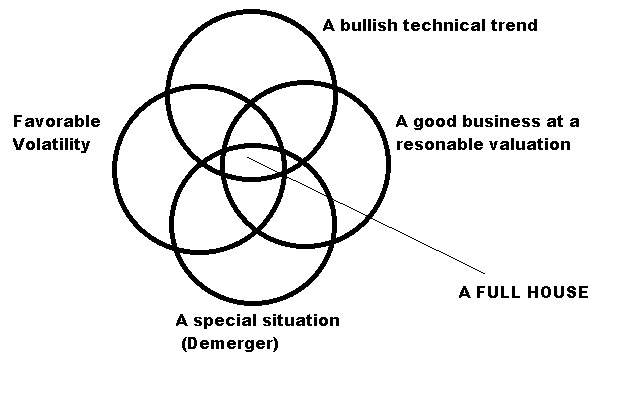
It’s a Full House!

Hi,
Hope you are in good health

Over the period of last 5 years, I have worked across different verticals of financial markets, my roles along my journey were
– A fixed income derivative trader (short term trading of euribor)
– A volatility trader(traded VStoxx, S&P VIX, India VIX )

– A technical analyst

– Equity research analyst

– Financial advisor ( Mutual fund, structured products, etc)

– Market/delta neutral trader

These different roles have helped me hone specific skill sets like
– Technical analysis of charts and price action
– Fundamental analysis of a company and valuation

– to read market behaviour from volatility trends

– Risk management and hedging skills

– Capital allocation

– to evaluate special situations like demerger, rights issue, etc

The point is whenever I find a idea at the intersection of these skills, I call it a “FULL HOUSE”. In poker, a full house is a combination of a pair and three of a kind.

The crux:
The company is mainly engaged in development, maintenance and operation of airports, generation of power, coal mining and exploration activities, development of highways, development, maintenance and operation of special economic zones, and construction business including Engineering, Procurement and Construction (EPC) contracting activities.

There is a special situation, in which, the non-airport business is getting demerged from the airports business.
We can own high yield assets with concession term of 60 years.


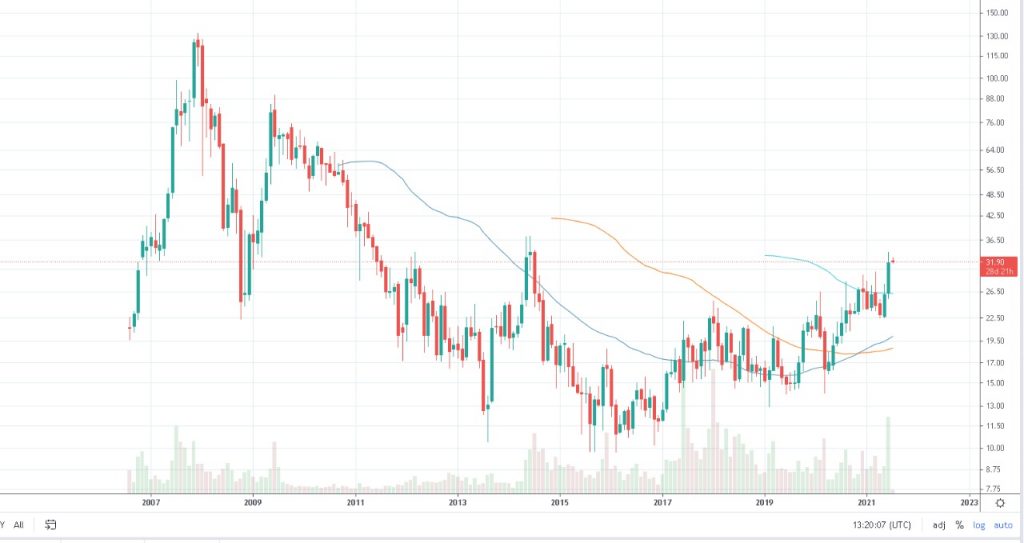
The technical chart

As a rule of thumb,
– I only play poker with the money I can afford to loose!
– I bet substantially on a full house, all in.
In poker, there is instant gratification since cards open quickly.
However, in markets, there is delayed gratification, the story/ cards will open over a period of years. Thus making it more intellectually stimulating and fun!

Let’s see how the cards unfold!

Cheers,
Warm Regards,
Bhuvan P Batra

Disclaimer: The above information is for educational purpose only. The author is not a SEBI registered advisor. Kindly consult your financial advisor before taking any decision.

Categories
Insights

A simple strategy to get Nifty’s upside with a little downside!

Hope you are safe and in good health.

Let say, for example, we have 15 Lakhs which we want to invest in Nifty Exchange Traded Fund (ETF).

We can buy Nifty from the futures market at 18- 20% margin. Nifty closed on 10th July, 2020 at 10768, multiplying by lot size 75, we get approx Rs 8 lakhs per lot. After keeping 3 lakhs margin, we can buy 2 lots of Nifty futures worth of Rs 16 lakhs. However, the future expires every month on last Thursday, so we have to roll it over every month.

Now we can buy LEAPS (Long term equity Anticipation Securities), is nothing but an insurance for portfolio, we need to buy a long dated put option of Dec 2021 Nifty PE at 800, multiply by lot size 75, we get Rs 60k. That makes it Rs 1.2 lakhs for 2 lots of protection.

We are left with Rs 11.8 lakhs (15-3-1.2), simply keep it in a liquid fund till Dec 2021 yielding 5% approx, this will fetch us cash flow of about Rs 90k for one and a half year at 5%.

The idea is simple, we need to fund our protection (LEAPS) with the cash flow from liquid fund. The LEAP is costing us 7.4 % for one and a half year, roughly 5% per year, which we are funding from liquid fund.

Generally, when we roll over Nifty futures we pay 25 to 30 points premium, since the forward future is more expensive than the current one. Normally, the cost of rolling Nifty futures comes out to be 3-4% per year and the cost of LEAPS also is around 4%, the net cost to us is 7%. However since last 3 months, we are getting paid for rolling over Nifty futures. The LEAPS are a little expensive currently due to high volatility and uncertainty in the markets.

The pay off for this strategy is we don’t lose money if Nifty falls below 10500 and if Nifty kind of gains 12% from here, we can make about 10%, not bad at all.

It’s like heads we win, tails we don’t loose!

A lot of big institutions, hedge funds, banks, etc use this simple strategy.

If you are an investor, you can also hedge your portfolio by buying LEAPS. However, the volatility and standard deviation of your portfolio should mimic the volatility and standard deviation of our benchmark Nifty 50.

To put it simply, if you have a large cap dominated portfolio, LEAPS would do okay to protect your capital, however, if you have a small cap dominated portfolio, it might not work in your favor every time.

This simple strategy can give you Nifty’s upside return over the long term with a little volatility on the downside.

If you find the above information valuable, kindly do a favor
1.) In these challenging times, help someone who is in need.
2.) Share this with at least one person.

Happy Investing,

Bhuvan P Batra

Disclaimer: The above information is for educational purpose only, and should not be considered as investment advice. Kindly consult your advisor before investing!

Categories
Insights

What next?

The economy is gradually opening up, and the  markets have recovered sharply. We need to prepare for the worst, and I think preparation has to be a habit, rather than a one time act . Even though at times, we may have to sacrifice short term returns. Our ability to withstand future storms will depend on how deep our roots are!

While we look to the past for the worst case, there’s no reason why future experience will be limited to the past. Having said that, but without reliance from the  past to inform us regarding the worst case, we can’t know much about how to invest. Let’s look at some of the past  financial crises.

The Great Depression 1929,

The Dow Jones crashed- 50% down in a quarter from peak, and in the next 5 months retraced +50% from the low, only to plunge -85% in the next two years.

Can Nifty correct another -80% from 10000? I don’t know!

Are we prepared for such a fall? Absolutely, Yes!

What is the probability of -80% fall from 10K? I think less than 10%

The panic of 1987,

The Dow Jones plunged -41% in a couple of months from 2746 to 1616 in 1987. After which we have never seen 1616 levels, it took a year to recover to previous high and as I am writing this Dow Jones is trading at 27111 as on 5th June 2020.

Covid-19 crisis in 2020

Nifty has corrected -40% approx from peak of 12430 to 7511, only to retrace 35% to 10140.

Will Nifty never see 7511? I don’t know

For having a look at past crises in the Indian financial markets go to http://www.nooreshtech.co.in/2020/05/opportunities-in-bear-markets-and-consolidations-post-1992-2000-2008-and-2020.html

Happy investing

Bhuvan Batra